
Guide · November 2026 · 3 min read
Building an Energy-Efficient Custom Home in North Idaho
In North Idaho, energy efficiency is mostly a winter question. A house that holds its heat through a January cold snap is quieter, more comfortable and cheaper to run for as long as you own it. Most of what decides that is settled on paper, before the foundation is poured, and very little of it can be fixed later.
Start with your climate zone
The energy code sorts the country into climate zones. Kootenai County, which takes in Coeur d’Alene, Hayden, Post Falls, Rathdrum and Athol, is zone 5B. Bonner and Boundary counties to the north, around Sandpoint and beyond, are 6B, which is colder and carries stricter requirements. If you are building near the county line, it is worth confirming which side your parcel falls on.
What the code requires, and what it does not
Idaho adopted the 2018 International Energy Conservation Code with state amendments, effective January 1, 2021, and Kootenai County builds to it. Among other things, a new home in zones 5 and 6 is held to an air leakage limit of 5 air changes per hour at 50 pascals, the figure a blower door test measures.
That is a real standard, and it is also a floor. Code is the least a house is allowed to be. The homes that feel genuinely comfortable here are the ones where efficiency was a design goal rather than an inspection to pass.
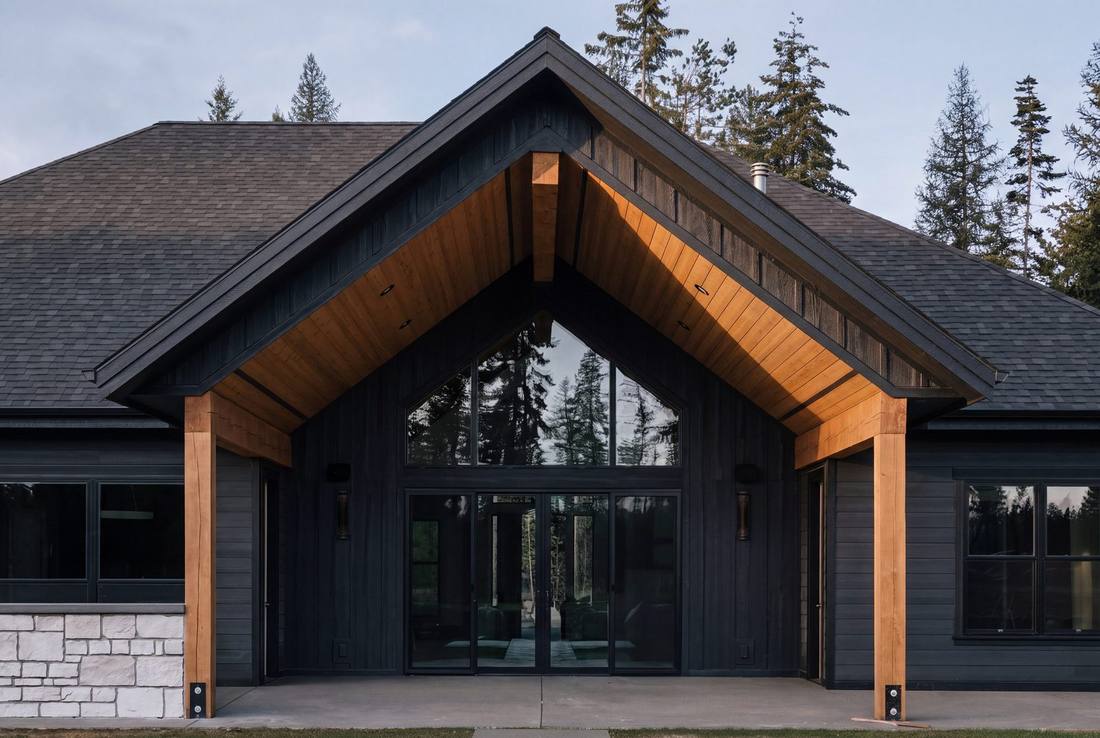
The envelope comes first
The envelope is everything that separates inside from outside: the foundation, walls, roof, windows and doors, and how well the joints between them are sealed. Continuous insulation without gaps, careful air sealing at the rim joists, top plates and every penetration, and an attic that is insulated and vented properly do more for comfort than any piece of equipment.
It is also the part that is nearly impossible to improve once the drywall is up. That is why a high-performance envelope is part of our standard rather than an option.
Windows: the big decision
Nobody builds in North Idaho to look at a wall, and the view is usually the point of the lot. Glass also loses far more heat than an insulated wall, so the windows deserve real attention: a low U-factor, frames that hold up to cold, and placement that takes in low winter sun on the south while limiting hard western glare in summer. Big glass walls are worth it, and they are worth specifying well.
Heat, air and the tight house
A study of homes built under Idaho’s 2018 code found that most use natural gas for both space heating and water heating. Gas is common and works well where it is available. On acreage without a gas line, propane or an electric heat pump takes over, and cold-climate heat pumps have become a serious option. Whatever the system, keeping ducts inside the conditioned space and sizing equipment to the actual house, rather than by rule of thumb, both pay off every month.
A tight house needs fresh air on purpose. Mechanical ventilation, often a heat or energy recovery ventilator, keeps the air clean without throwing heat away. And a wood stove or fireplace is a fine backup for the night the power goes out.
Rebates and credits
Incentives change often. Federal tax credits that once helped homeowners pay for heat pumps have expired, and utility programs come and go. Before you finalize equipment, ask your utility, whether that is Avista, Kootenai Electric or another provider, what it currently offers for new construction.
Questions to ask your builder
- What climate zone and code is my home being designed to?
- Will the house be blower door tested, and what result are you aiming for?
- How is the house ventilated?
- Where do the ducts run?
- What window specification are you proposing, and why?
Efficiency is one piece of designing for North Idaho winters. If you are planning a build, tell us about it.
Sources: International Energy Conservation Code climate zone tables; Kootenai County Residential Building Guide; Idaho residential energy code summary (2018 IECC with Idaho amendments); Northwest Energy Efficiency Alliance, Idaho Residential Code Compliance Evaluation. Incentives change; confirm current offers with your utility.
← Back to the JournalMore from News & Journal.
Designing a Home for North Idaho Winters
Snow loads, frost depth, roof lines, entries and heat — designing a custom home that is comfortable through a North Idaho winter, not just photogenic in June.
Read the story ›The Safe Haven Standard
Ten-foot ceilings, nine-foot solid Alder doors, natural stone and timber — the standard we hold on every home, because it’s the one we’d want in our own.
Read the story ›Single-Level Homes Built to Age in Place
A main-floor primary suite, curbless showers and an easy way in from the garage — designing a custom home you can stay in for decades.
Read the story ›